Skip to main content
ZnO hierarchical nanostructures and their application as efficient photoanode for quasi-solid dye-sensitizted solar cells (DSSCs)
Objective
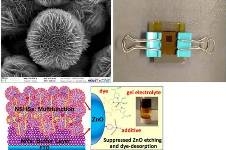
- To synthesize novel ZnO hierarchical structures for high efficiency DSSCs.
- To solve the stability problem of the conventional DSSCs based on liquid electrolyte.
- Rational design of the device structure to improve the efficiency.
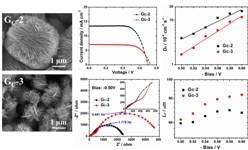
- Investigation of the optical and electrical properties of the solar cell devices.
Approach
- The ZnO hierarchical structures are obtained by a facile direct precipitation method.
- The solar cell devices are fabricated by doctor-blade approach with the quasi-solid electrolyte sandwiched between the ZnO film and counter electrode.
Impact
- Up to now, most of the reported ZnO-DSSCs are fabricated with liquid electrolytes. Therefore, the long-term durability is poor due to the surface chemistry problem at the ZnO/dye/electrolyte interfaces. Compared with this, our quasi-solid electrolyte can effectively avoid this problem, which is suitable for practical application.
- The efficiency of our ZnO hierarchical structures based DSSCs has achieved 6.83% . This is the record efficiency for quasi-solid ZnO DSSCs, and the second high efficiency for all kinds of ZnO DSSCs (the highest efficiency of ZnO DSSCs is 7.5%, based on the liquid electrolyte).
- The direct precipitation for massive production of ZnO hierarchical structures is a facile and economical method. This approach does not involve high temperature treatment and complex experimental process. This feature is very favorable for the industrial production.